
Morning Ritual
Different communities had different gestures, and a sign in one meant something very different in another. Where in one community they spread their hands to convey happiness, in the other the same gesture was used to express grief.
I have spent my life in fruitless pursuits. And I now spend most of my time wondering what, if anything at all, I gained from them. This is my new, perhaps my last, and maybe even my most futile pursuit.
For years I roamed the length and breadth of my country. My aim was perhaps to get to know its large and small cities, but the result of these tours was simply that all the cities except my own began to look the same to me, and I returned home where I spent several months in seclusion. Then my heart grew restless, and I set out again. This time I turned towards the rural settlements. But it didn’t take me long to realize that these settlements were not very different from the urban ones, or at least they did not seem so to me. I came away and for a long time was troubled by the apprehension that I’d lost my ability to distinguish between things. I kept this misgiving to myself, trying not to show it in anything I said or did. But when I noticed my daily acquaintances looking at me strangely, I set out on another journey.
During my travels I wandered through the desolate regions of my ancient land. The climate in these places was harsh and the soil poor; rivers were far from them and it was not possible for people used to more than the very basic facilities to settle there. Nevertheless, these regions were not empty of people. I also passed through areas where humans had perhaps never lived – these were merely large, uninhabited geographical tracts that in a vague manner resembled oceans, but they did not seem desolate, even though no one lived there. In fact, the places that seemed bleak were the ones where humans had been living since ancient times. These areas would suddenly come into view like islands within the unpeopled geographical expanse. It could be that they seemed barren only because humans had settled there, and just as people left their impact on the terrain where they lived, the terrain too influenced its inhabitants – you could tell even when you saw these people in the lively cities, that they had come from those barren stretches. At least I could, for I had spent a large part of my travels wandering in their midst.
These were small communities and each community was distinct from the other – or certainly seemed so to me. Observing these communities and spending time with them was my main occupation during my travels. I was interested in these scattered groups of people because they were steadily dying out. Any sudden epidemic or major shift in the weather could easily wipe them out, and often did. It happened a few times that passing through a place where I’d earlier stayed, I found the community no longer there, and the area almost indistinguishable from the adjacent geographical expanse, perhaps because the traces left behind by these people tended to fade very quickly.
I could not obtain much information about these communities, for even though they knew my language a little, I couldn’t make sense of their dialect, which meant we could converse only through signs. But this wasn’t much help to me either. Different communities had different gestures, and a sign in one meant something very different in another. Where in one community they spread their hands to convey happiness, in the other the same gesture was used to express grief. A head shake meant agreement in one community, and indicated denial in another. To be able to correctly interpret their gestures you’d have to be with them for a considerable stretch of time, and I was never with one clan long enough to make sense of their signs. Whatever I did learn from their gestures was unreliable, and I forgot this confusing information even before I left. What remained fixed in my memory was the nudba, their ritual of mourning, which though distinct for each clan could still be recognized.
I cannot say if the unusually high number of deaths among these communities was simply a coincidence, but a death was sure to take place on the second or third day of my arrival, being announced by the wailing and moaning of the deceased person's closest relatives, or the closest relatives of those relatives. The other people of the community gently approached the mourners, calmed them down and then returned as gently as they had come. Some would get busy with the funeral arrangements and once these were in place, the whole community would gather at a specified time and place, in some communities before and in others after the funeral, to perform the nudba, which was their ritual of collective lament.
Usually, the nudba began with an invective against death and soon gave way to remembrance of the deceased and the lament kept intensifying in pitch and tempo. At its peak, the mourners would be gripped by a strong emotion, which was expressed through their body movements, their voices, and above all, their eyes that conveyed anger rather than grief. Sometimes it seemed as if they had all consumed a powerful intoxicant. I too, now and then, was obliged to participate in this ritual, and I’d find myself clumsily copying what the others did, without really feeling any genuine emotion. At the end of the lament people consoled each other and at such times, I too, would be offered consolation.
At the collective lament, the number of women was sometimes greater than that of the men and sometimes there were more men than women, but in one community, the number of both sexes was exactly the same. I closely observed, and even touched the women in this clan during the ritual lament. These women were short and dark-complexioned and nature had been generous in filling out the parts of their bodies that identified them as women, so that they seemed to be the originals of those ancient statues and murals said to have been made by artists who had never seen a real woman, at least not from up close, and had certainly never touched one.
In this community, during the nudba ritual the men would sit kneeling on the bare ground in one row, and the women in a second row facing them. These facing pairs would touch elbows, then wrists, then slap palms together, and intertwining their fingers, they’d say whatever they had to. They would separate, then again touch elbows and wrists, then slap each other’s palms and intertwining fingers, they’d speak again. Their lament would peak and subside, then peak again and fall away, resembling the ebb and flow of the ocean till their eyes rolled back, and finally, sweating profusely, they’d end the nudba in weak, trembling voices and, panting, slowly separate.
Three deaths took place in this community while I was there. I participated in the nudba alongside the mourners for the first two deaths, but the third was the death of my own host, who was a frail old man. I had even treated him with some medicines I had with me, but he could not be saved. He reminded me of my own father not just in appearance but also in many of his mannerisms, and I’d tried to convey this to him through word and gesture. I don't know what he had told the other folk about me, but after his death, one or two of those who were trying to console the mourners came to me too, and even though I was silent, they still pacified me. Their coming put me in mind of the day my father died. There’d been a discordant noise of women weeping in my house, and I’d sat quietly, away from everyone.
On the death of my host, I’d been haunted by my father’s face as he lay there dying. Then the face of my old host began to come back to me. After the funeral arrangements were done, when the folk of the community began to form rows facing each other, I got up without a word and made my way towards the uninhabited wasteland nearby. There I decided to immediately end my travel and started on my journey back that very day.
*
Now, as I mentioned, I spend most of my time contemplating what I have gained from my pursuits. My life, the greater part of which has passed moving from one excitement to another, has been relatively dull for a long time. One day, however, there was some excitement which perhaps was a consequence of one of my pursuits, but turned out to be even more fruitless than the pursuit.
2
That day early in the morning there was a knock on my door that opens onto the bazar. I lazily got up and when I opened the door, I saw the mad boy of the neighbourhood standing there with a crumpled piece of paper in his hand. Seeing me he thrust the paper into my hand and ran away laughing. It was his habit to pick up discarded things from the bazar and give them to others. He called this "giving a prize" and people in the bazar would repeatedly ask him for such prizes.
So today I got a prize without asking, I thought to myself, as I closed the door, and got busy with my daily chores. I also wondered, as I would, now and then, what it was about this boy that made people consider him mad. There was nothing unusual about him, except that he was always happy and laughed at the slightest pretext. Nevertheless, everyone thought him mad, and so did I. After a while, there was another knock on the same door. I opened it again. It was the same boy.
"They're calling you," he said, suppressing his laughter.
"Who's calling me?" I asked.
"The ones who have come."
"Who has come?"
"The scraps-of-paper people" he said, and laughing loudly, ran away.
I closed the door and picked up the scrap of paper that I’d left lying on the bed. The paper was old and my name and address were written on it in my own handwriting – in a script that seemed to belong to those times when I wrote carefully, making the letters beautiful. I remembered those times. I also remembered that I had spent some of them wandering among the communities in those barren regions. I couldn't recall when or where I had written on this shred of paper, but I did remember generously distributing at the time such scraps of paper among the clans I came across. This was the only reward I gave them for their hospitality. I also emphasized – mostly in wrong or awkward sign language – that if anyone ever needed something done in the city, they should use these pieces of paper with my writing on them to come straight to me.
I thought that I wouldn’t see those bits of paper again. But now, after all this time, one of them with my handwriting on it was in my hand, and although the messenger was considered mad by everyone including me, I received the news that some people had reached me using one of these pieces of paper and were asking for me. Within a few moments, all the communities I had seen spun through my mind like scenes from a dream and vanished. I left the house and came out into the bazar.
It was time for the shops to open, but most of them were still closed. The shopkeepers, however, were present, clustered together and murmuring among themselves. They came up when they saw me.
"Who brought this?" I asked, showing them the piece of paper. Silently, they indicated the nameless dirt track which led towards the north, its mouth nearly blocked off by the bazar’s garbage dump. I looked where they pointed. There seemed to be small heaps of garbage scattered all over the area beyond the dump, but when I looked again, I saw that they were a group of people crouching on the ground.
"Who are these people?" a shopkeeper asked me.
"Looks like some clan," I said, and was about to make my way there when another shopkeeper said to me: "Did you call them?"
"No," I said.
"Even so, it’s you they want to meet."
"But I didn't call them."
"Well, at least get their cart moved. It's blocking the road."
I now saw the vehicle parked on the paved road. A large barrel had been cut vertically down the middle. This gave it the shape of a small boat with a rounded bottom and no tapering ends, or perhaps it was an obsolete boat fitted with large round discs from an old tree trunk that served as wheels and readied it for movement on land. I looked at the cart more closely and realized what I’d thought was a barrel was in fact also a hollowed-out tree trunk cut down the middle. Dangling beneath the cart, almost scraping the ground, was a large oddly shaped stone that was tied to the cart with thick green ropes made of tree bark fibre. Its purpose was perhaps to maintain the cart's balance, yet two men covered in dust held it from both sides. Absentmindedly, I wondered if they let go, the cart would tip forward or backwards. Then I looked at the cart more closely.
The hollow of the cart was filled all the way to the top with rags, and a woman leaning over it kept shifting the rags about. She was wrapped in a sheet from head to toe, yet appeared young. I had just about been able to catch a glimpse of her and the two men holding the cart when I heard another shopkeeper's voice,
"Which clan is it?"
I turned and looked at the people squatting on the ground in front of the refuse dump. There were ten or twelve of them, and all of them were so covered in dust that it was hard to make out the colours of their clothes. The sight of these people brought nothing back to me. But I could tell that they came from the desolate regions. I watched them for a long time. They were all looking at me with indifference, and I was almost certain that I had never stayed in this community. I couldn't understand how they got my name and address. I looked closely at the piece of paper again. Just then they too noticed the scrap of paper in my hand and suddenly life surged through them. They quickly said something to each other and then stood up. A little dust rose from their clothes and I found myself encircled by them. I was also simultaneously met with a barrage of questions from the people of the bazar. To start with, they repeated their last question,
"Which clan is it?"
I told them I did not know these people, yet everyone continued to question me as though they thought I was responsible for them. Their questions were such that I couldn't answer them.
"Are these people unclean? Are they the cause of the sudden increase in thefts in the city? Where did they come from? Are they beggars?"
Then it was my turn to question them,
"Have they asked anyone for anything?"
"Not yet," I got the reply, "but they've been showing this paper to everyone ever since they arrived, asking your whereabouts."
"In which tongue?"
"Through gestures."
"Then?" I asked, "They weren’t begging too through gestures, were they?"
"But look at their appearance!"
"I am looking."
"And the cart..." the loudest shopkeeper said.
"I'm looking at that too."
"And look who they’ve brought along in the cart? If he dies here, won't they come crying to us for help? These are all ploys to make money."
I now looked at the cart's occupant. Until now, I’d thought that the rags filling up the cart had risen a little higher, but it was the drooping head of its occupant, and the woman kept supporting it, only for it to droop again. I advanced closer to him. The woman was now holding his head with both hands and lifting it when I heard the voices of all the people at the same time and I turned towards them.
They were repeatedly touching my knees and speaking. Their tongue seemed to be a corrupted – or beginning to be corrupted – form of my own language, which I couldn't understand. They’d touch my knees, then point toward the cart, and their tone would become pleading. At that moment I too suspected that this was a group of beggars. After exchanging only a few words with them, I realized that they also did not understand my language, and my flat accent did not allow them to guess what I was saying. Their own accents were varied, but I gathered that they were troubled by some great fear, had endured all sorts of hardships to get here, wanted some kind of help from me, and that all of this was connected to the occupant of the cart.
During this time, the woman was constantly adjusting the man’s position and supporting his drooping head. I came right up to her. The man in the cart was buried up to his chest in rags and his head too had rags wrapped around it. The woman moved aside and lifted his face with both hands, turning it towards me.
Before me was a child's swollen face. His eyelids were extremely puffy. There was a slight slit in one eyelid through which he was looking at me. The other eyelid was completely closed, but lime or some other white substance had been smeared on it and a large eye made of kohl or another kind of blacking had been drawn in the centre, giving the illusion of an eye on the swollen eyelid, wide open in astonishment. I turned my gaze from this astonished eye and bent down to peer into the slit of the other eye. Hidden behind the tangled lashes, the look held suffering, entreaty, and weariness. I tried to look more closely at his face and ripples seemed to appear in the rags stuffed into the cart. The man jerked his face back. His lips puckered, and his teeth became visible. From a distance the shopkeepers may have thought he was laughing, but to me, he looked like a sick dog fearful of the mischievous boys coming towards him.
I heard the hum of the people from the bazar and the loud voices of the community members behind me. I suspected they had started squabbling. I turned around. Both groups were saying something to me, but I couldn't understand anything that anyone said. Just then, the woman gripped my hand and I turned towards her. She put her other hand into the rags and after feeling around, pulled out up till the elbow, one of the man's arms. There were three hands before me: my own familiar hand, the woman's soft, pale, and slowly sweating hand, its fingers intertwined with mine, and between our two palms, the cart-rider's small, shrivelled hand with the wrist and forearm wrapped in multi-coloured threads between the gaps of which was visible the dead-looking wrinkled skin.
The woman's fingers pulsed like a heart within mine. I felt a slight shiver, and the cart-rider let out a sound. Like that sick dog being approached by mischief-making boys. A shopkeeper placed his hand on my shoulder, and I turned to him.
"Get the cart moved," he was saying. "Our business is getting ruined. These people so early in the morning..."
I turned to the clan members. They were all now silently staring at me. I gestured to them to travel towards the west along the straight road and they understood immediately. The men supporting the cart easily turned it in the direction towards which I’d pointed. The woman released my hand and placed the cart-rider's hand back into the rags, then began to hold up his head. The cart moved forward with a faint rattling sound. Behind it walked the clan folk, clutching their dirty bundles and holding long staffs in their hands, while on both sides of the road, the shopkeepers and other neighbourhood people, including some women and children, stood silently.
Walking quickly ahead of the cart and leaving the line of shops behind, I reached the southern bend of the paved road and stopped. Again, I gestured to them to stop at the bend, and they haltingly came up where I was. Dust swirled around them like smoke, and all at once everything became visible to me. All of them as well as each object seemed exhausted, dilapidated, and on the verge of collapse. Yet, I thought, if everything hadn’t been so covered in dust and if the stone hanging beneath the cart had been more symmetrical, this procession could well have been mistaken for a royal cavalcade.
They stopped near me. I saw the people from the bazar a short distance behind them heading toward their shops and the lines of spectators dispersing. Then I turned my attention to the people who’d come from the desolate areas, and they seemed to understand that now I had the time to listen to them. They too began to speak at length. What I understood was that they were giving me details about the occupant of the cart. But only one part of those details made sense to me: that the cart's occupant was the last one. While wandering in the small communities, the meaning of "the last one" had been expressed so often in different dialects and gestures that I could now easily understand it. Almost every person in this community would touch my knees after describing the condition of the cart’s occupant and plead that he was the last one.
For no particular reason I felt responsible for them, especially for the man in the cart, and I made a sign for them to relax, to remain calm. They fell silent and looked at me, then they signalled to one another to relax, and they actually looked relieved. I motioned to them to wait right there, and walking quickly, as if I’d return immediately, I arrived at the door of my house. The mad boy was standing at the door and seemed frightened.
"Who are those people?" he asked in a muffled voice.
"The scraps-of-paper people," I replied. "Didn't you give them a prize?"
"A prize?" he asked, as if he hadn't understood anything. I patted his shoulder and said, "Go run and get a prize, and then we'll go to them."
"No," he said, looking even more frightened. "Alright, go play," I said. "I have work to do."
"Who is that old man?"
"Old man?"
"The one hidden in the cart..."
"He's not an old man," I said.
And then I felt a little shock. Why had I assumed he was a child? He could just as well have been an old man. I remembered his appearance. His face was swollen and his hands wrinkled. I strained my memory to recall the shape of his hand, but instead I remembered the woman's white, sweating hand, its fingers intertwined with mine and beating like a heart. I jerked my head violently and tried to recall the words and gestures of the clan people. All I had understood was that he was the last one. The community's last child, or its last old man? The last sign of a person or of an event? The last relic of an object or a time? My mind became more and more confused, and perhaps I spent a lot of time in this confusion, because when I decided to go and see the man again, the mad boy was gone, and afternoon was closing in.
I walked ahead leaving behind the garbage dump and the line of shops, and saw that they were all coming towards me. The cart was in front. Its occupant's face was propped on the edge of the cart, and the rags wrapped around his head had come undone in places. The woman was repeatedly trying to climb into the cart herself, and each time one of the men would grab her and pull her back. I heard their voices behind the rattling of the cart. They seemed to be singing. One of them would say something and everyone would together repeat his last words. They had formed a line, and their voices were getting louder. One man stepped slightly ahead of the line, chanted something, and everyone repeated it. That man returned to the line, and another stepped forward. His voice as well as the answering voices of the others were louder than the previous ones. And now their hands and bodies were moving in something like a dancing manner. After a short while, one man would step forward, say something in which everyone joined and then they fell silent, nodding their heads as if in applause. I thought this was how they applauded, though I did not know what the nodding of heads meant in this community.
Even though I was right in front of their eyes, perhaps they could not see me. I was slowly backing away as they advanced. My ears were focused on their voices and my eyes on their movements. They were narrating a story, and the vague scenes of that story were forming and dissolving before me like outlines in a dream. I saw a newborn being cuddled by many. The child is learning to walk. He walks unsteadily, falls down and cries. He is picked up, comforted, and is now soothed. He is running. He is climbing a tree. He has fallen asleep from exhaustion. He has woken up. He is rubbing his eyes with his palms, and both his eyes have turned red.
I saw many pairs of red eyes advancing towards me. Now they were all saying "the last one, the last one" together in the same tune, making the same gesture, and their voices were cracking. A feverish excitement had come over them, and they seemed maddened by anger. Then a kind of intoxication took over everyone. The dust emerging from their clothes and rising from their feet enveloped them. Behind the dust, the woman was again holding up the cart occupant's face. The slit in his eye was closed. But the other eye – white and black – was watching me in astonishment and did not close even when it was covered in dust. The cart passed over a rut in the road. Its occupant's head got jolted and the rags wrapped around it opened further. Blame flickered in the eye, then anger, then something like a slight intoxication, and it began to look at me with astonishment again.
As they approached the line of shops, all of them fell silent and stopped. They seemed exhausted and unaware of my presence. They consulted among themselves and began to point toward the door of my house which was in the distance. I turned and walked quickly toward my house. A little before reaching the door I turned back. They were now pointing in my direction and saying something to each other. They then began to advance towards me. I turned, walked about forty steps past my door, and stopped again. I slowly turned and looked at them, and they appeared to me like a shifting heap of rubbish. Then their formation broke, and they all bowed their heads.
For a long time, I was overwhelmed by the feeling that I had witnessed a scene that I would never see again. I also had a slight regret that I had not participated in the scene myself. However, I felt very safe because now those people were descending onto the unnamed dirt road that turned to the north, which led out of the city toward the desolate regions.
Translated from Urdu by Sara Rai
Sara Rai is a contemporary Indian writer, translator and editor of modern Hindi and Urdu fiction. She lives in Prayagraj. Rai mainly writes and publishes short stories in Hindi. Written in a reflective prose style, her stories explore the individual complexities in the lives of ordinary people and outsiders in contemporary India. She is the grand daughter of the writer Munshi Premchand, the pioneer of Hindi and Urdu social fiction.
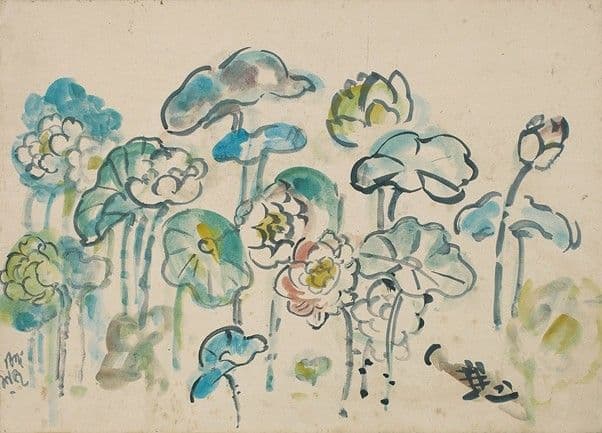
Photo Credit: Benode Behari Mukherjee, Watercolor on paper pasted on mount board, 1952.
Source - www.theheritagelab.in
Share this article